

If you searched for CPC meaning, you’re probably reading an advertising report, setting a budget, or checking whether traffic costs too much. The term is simple, but the cheapest click isn’t always the most useful one.
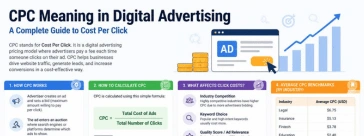
CPC stands for cost per click. It is the amount an advertiser pays, on average, when someone clicks a paid ad. To calculate it, divide total ad spend by total clicks. The metric shows the price of traffic, but it cannot tell you whether those clicks became profitable customers.
| Key point | What it means |
| Cost per click | The amount paid for a click on a paid advertisement |
| Formula | Total ad spend ÷ total clicks. |
| Maximum bid | The most an advertiser is generally willing to bid for a click. |
| Actual click cost | The final amount charged for an individual click |
| Average click cost | Total click costs divided by total clicks |
| Best used with | Conversion rate, CPA, revenue, and ROAS |
CPC Meaning: What Cost Per Click Tells an Advertiser
In Google Ads, CPC bidding means an advertiser pays when somebody clicks an ad. An advertiser can set a maximum bid, but the final amount charged is often lower. Google refers to that final charge as the actual cost per click.That makes the metric useful for measuring the cost of bringing a visitor from an advertisement to a website, an app, a product page, or a landing page.
CPC Meaning If you’re new to paid media, AdsS Paper’s overview of digital advertising services explains how search, social, display, and other ad formats fit into a broader marketing plan.Publishers may see the term from the other side. Google AdSense defines cost per click as the amount a publisher earns when a visitor clicks an advertisement. The advertiser determines the value of that click.
How to Calculate Cost Per Click
The basic formula is:
Cost per click = total advertising cost ÷ total number of clicks
Google uses the same calculation for average click cost in its reporting guidance.
Suppose a campaign spends $600 and produces 300 clicks.
$600 ÷ 300 = $2 per click
That number tells you how much the traffic cost. It doesn’t tell you whether the traffic made money.
Imagine that 12 of those 300 visitors become customers. The campaign then has a 4% conversion rate and a $50 cost per conversion.
This simple example shows why marketers should follow the click through the rest of the funnel.
Maximum, Actual, and Average Click Cost
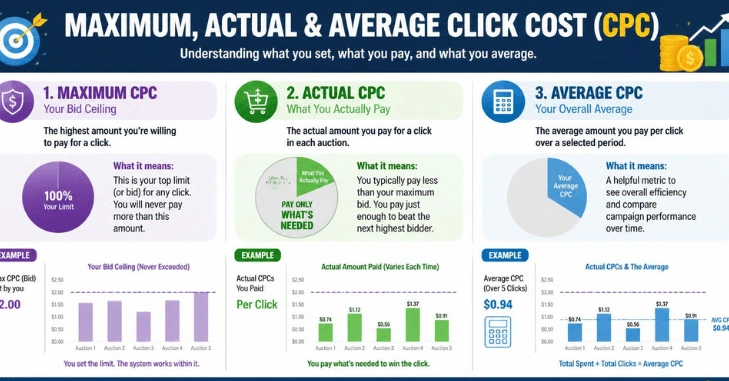
These terms sound similar, but they answer different questions.
| Term | What it tells you | Example |
| Maximum click bid | Your usual bidding ceiling | You set a $3 maximum |
| Actual click cost | What one click costs finally | The auction charges $2.35 |
| Average click cost | Average across several clicks | 100 clicks cost $240, averaging $2.40 |
Google notes that the actual charge is often below the maximum bid. The auction can also consider ad quality, competition, search context, and other ranking signals.
This distinction matters when reviewing campaign reports. A bid is an input. The amount charged is an outcome.
Cost Per Click vs. PPC vs. CPM
Paid-media terms often overlap, which can make reports confusing.
| Term | Main idea | Best question it answers |
| Cost per click | A performance metric | “What did each click cost?” |
| PPC | A pay-per-click advertising model | “How are we paying for traffic?” |
| CPM | Cost per 1,000 impressions | “What does it cost to reach an audience?” |
PPC and cost per click are closely related. Google even notes that click-based pricing is sometimes referred to as PPC. In practical reporting, PPC usually describes the advertising model, while the click-cost metric measures its price. There is more on this in How Much Does SEO Cost in South Africa.
CPM focuses on impressions instead of visits. It is often more relevant when reach or brand visibility matters more than immediate site traffic.
What Is a Good Cost Per Click?
There is no universal good CPC that works for every business.
A $6 click could be excellent for a high-value service. A $1 click could be wasteful if none of those visitors buy anything.
A better question is: How much can you afford to pay for a click and still make the campaign worthwhile?
A simplified break-even calculation can help:
Break-even click cost ≈ value per conversion × conversion rate
Suppose a sale contributes $80 before advertising costs. If 5% of ad visitors buy, the simplified break-even click value is $4.hat doesn’t mean every bid should be set at $4. Other costs still matter. The calculation gives you a business-based reference point instead of an arbitrary industry average.Current marketing guidance also stresses that a good click price depends on economics, competition, conversion performance, and campaign goals rather than on one universal benchmark.
What Makes Click Costs Rise or Fall?
Paid search uses an auction, so click prices can move even when your budget stays unchanged.
Google says several auction-time factors can influence ad position and the price paid. These include expected click-through rate, ad relevance, landing-page experience, competition, bid levels, search context, and ad assets.
In practical terms, watch these areas:
- Competition: More advertisers bidding for the same audience can increase prices.
- Search intent: Commercial keywords often attract stronger bidding than broad informational searches.
- Ad relevance: Clear alignment between the search, advertisement, and landing page can help improve campaign efficiency.
- Targeting: Location, device, audience, schedule, and match type can change traffic costs.
- Bid strategy: Automated and manual bidding can produce different auction behavior.
A higher price isn’t automatically a problem. Paying more for visitors who convert at a much higher rate may improve profitability.
How to Reduce Click Costs Without Buying Worse Traffic
Cutting bids unthinkingly can lower traffic quality. A stronger approach is to remove wasted spend first.Start by reviewing the actual search terms that trigger your ads. Add negative keywords when a query doesn’t match your offer. Separate high-intent searches from broad research terms so they don’t compete for the same budget.
Next, improve the connection between the keyword, ad copy, and landing page. Visitors should immediately find what the advertisement promised.Test different headlines and calls to action. Keep useful experiments separate so you can see what changed rather than having to guess.
Most importantly, read click costs alongside conversion data. AdsS Paper’s guide to marketing touchpoints and sales attribution explains why isolated metrics can miss what happens later in the customer journey.A cheap click that never converts is expensive traffic. A higher-priced click that repeatedly produces profitable customers may be the better investment.
Final Verdict
CPC Meaning Cost per click tells you what paid traffic costs. It does not tell you what that traffic is worth.Use it alongside conversion rate, CPA, revenue, and ROAS before making any bid or budget changes. When performance is stable and profitable, scaling becomes a different question.
If you’re considering broader reach, read AdsS Paper’s guide to expanding a commercial CPC campaign into new markets. It covers the performance signals to review before moving a successful campaign into new markets.
Frequently Asked Questions
CPC is the amount charged per paid advertising click. Advertisers use it to understand the price of traffic. The standard average calculation divides advertising spend by the number of clicks received.
They are closely connected but describe slightly different things. PPC is the pay-per-click advertising model. Cost per click measures the cost of each click in that model. Google also notes that click-based pricing is commonly referred to as PPC.
No. A low price is useful only when the traffic supports your goal. Conversion rate, cost per acquisition, customer value, and return on ad spend provide the click-price business context.
No. Google states that the actual amount paid is often lower than the maximum bid. The final charge depends on the ad auction and competitive conditions.
What is the CPC