

Posting often does not guarantee business growth. A social media marketing strategy connects every post, video, reply, and promotion to a defined business goal. For U.S. businesses, the strongest plan also considers platform usage, customer behavior, advertising costs, and measurable results.
Direct answer: A strong social strategy connects business goals with a defined audience, selected platforms, useful content, paid promotion, and measurement. Start with one meaningful business outcome and identify where your customers spend time. Publish content that supports customer decisions, track business results, and adjust the plan using performance data.
| Strategy element | What you need to decide | Useful outcome |
| Business goal | Awareness, leads, sales, bookings, or retention | Clear purpose |
| Audience | Needs, location, age, behavior, and buying stage | Better targeting |
| Platforms | Networks your customers use | Focused effort |
| Content | Topics, formats, message, and publishing rhythm | Consistent communication |
| Paid support | Budget, audience, offer, and campaign goal | Expanded reach |
| Engagement | Replies, support, and community interaction | Stronger relationships |
| Measurement | Leads, sales, CPA, revenue, and engagement | Evidence for decisions |
| Review cycle | What changes monthly or quarterly | Continuous improvement |
Key Takeaways
| Principle | Practical action |
| Start with outcomes | Choose one primary business result before creating content. |
| Focus your channels | Use platforms that fit your U.S. audience instead of joining every network. |
| Build repeatable content | Create several useful content themes tied to customer needs. |
| Measure customer actions | Connect social activity with leads, purchases, bookings, or revenue. |
| Review before expanding | Improve what already works before increasing channels or spending. |
What You Need Before Creating the Plan
Start with a clear offer, audience, and business objective. You also need a destination where interested people can take the next step. That destination might be a product page, booking form, store, phone line, or lead form.
Your social plan should also support the wider marketing program. AdsS Paper’s guide on advertising your business explains why the goal, audience, offer, and conversion path should come before channel selection. That same order prevents social activity from becoming disconnected posting.
How to Build a Social Media Marketing Strategy in 8 Steps
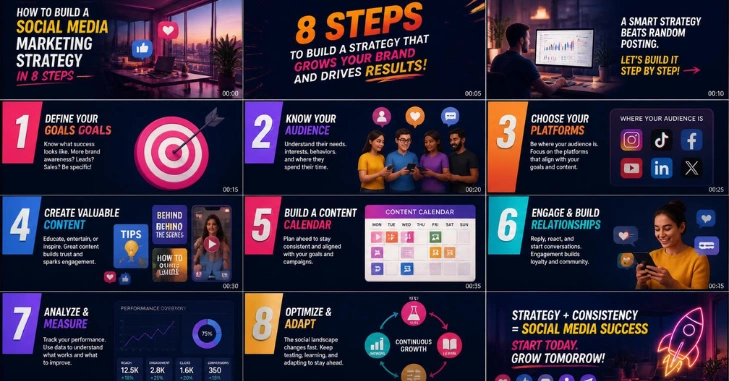
The process works best when each decision supports the next one. Avoid choosing platforms or creating a calendar before defining the desired result. These eight steps give U.S. businesses a practical sequence to follow.
- Choose one primary business goal. Decide whether social activity should produce awareness, leads, purchases, appointments, repeat customers, or another measurable result. Choose one primary goal for each campaign, because competing objectives make performance harder to judge. Match the goal with a metric that reflects a valuable customer action.
- Define the audience you need to reach. Describe customers using needs, behaviors, problems, location, and buying stage. Demographic information helps, but customer motivation gives content stronger direction. A local home-service company needs a different audience profile from a national consumer brand.
- Select platforms using audience evidence. Avoid maintaining accounts because competitors use them. Research where your intended customers spend time and how they use each network. Give your strongest channels enough attention before adding more platforms.
- Create three to five content themes. Each theme should answer a recurring customer question, problem, interest, or buying concern. A software company might cover tutorials, customer outcomes, product education, industry problems, and company expertise. Defined themes make planning easier without forcing every post into the same format.
- Set a realistic publishing rhythm. Choose a schedule your team can maintain without lowering quality. The right frequency depends on resources, customer behavior, and platform format. Consistency matters more than filling a calendar with weak posts.
- Combine organic activity with selective paid support. Organic posts help educate followers and maintain customer relationships. Paid distribution can reach defined audiences beyond existing followers. AdsS Paper’s overview of digital advertising services can help you compare paid social with other online advertising channels.
- Create a measurement system before launch. Track activity beyond views, likes, and follower growth. Connect campaigns with qualified leads, purchases, bookings, customer acquisition cost, and revenue where possible. AdsS Paper also explains how to connect marketing touchpoints with closed sales when customers interact with several channels.
- Review results and change one major variable at a time. Examine performance on a regular schedule instead of reacting to every post. Compare content themes, formats, audiences, offers, and conversion results. Controlled changes make it easier to understand what improved performance.
Choose Social Platforms for the U.S. Audience
A Social Media Marketing Strategy should consider platform size, but customer fit matters more. Pew Research Center surveyed U.S. adults in 2025 and found 84% used YouTube, 71% used Facebook, and 50% used Instagram. TikTok reached 37%, while usage patterns varied sharply by age.
| Platform | U.S. planning consideration | Potential business use |
| YouTube | Broad adult usage and strong video adoption | Education, demonstrations, reviews |
| Broad reach, especially among middle-aged groups | Communities, local offers, advertising | |
| Strong usage among younger adults | Visual products, creators, short video | |
| TikTok | Higher adoption among younger adults | Discovery, demonstrations, entertainment |
| Topic-focused communities | Research, discussion, niche audiences | |
| Professional context | B2B education, hiring, industry expertise |
Do not interpret national reach as proof that every business needs each channel. A platform becomes useful when the right customers use it for relevant discovery, research, conversation, or buying decisions. Concentrated effort usually creates better learning than scattered activity across six accounts.
Balance Organic Content and Paid Social Advertising
Organic activity gives a business space to educate customers, answer questions, and build familiarity. Paid campaigns expand distribution and allow tighter audience controls. The two approaches can support each other without sharing the same performance goals.
Use paid support when the business has a defined audience and a clear conversion path. Avoid spending money to send people toward an unclear offer or unfinished page. A broader creative brief can also align objectives, messages, formats, approvals, and success measures before production starts.
Measure Results That Affect the Business
Engagement metrics provide useful diagnostic information, but they should not stand alone. A post can generate many reactions without producing qualified customers. Measurement becomes stronger when you can connect attention to business outcomes.
| Objective | Useful primary metrics | Supporting metrics |
| Awareness | Reach, video views, branded searches | Follower growth |
| Lead generation | Qualified leads, cost per lead | Landing-page conversion rate |
| E-commerce | Purchases, revenue, ROAS | Product clicks |
| Local services | Calls, bookings, quote requests | Cost per booking |
| Customer retention | Repeat purchases, renewals | Engagement from customers |
Set reporting periods before campaigns begin. Weekly reports can identify unusual changes, while monthly reviews reveal stronger patterns. Quarterly reviews can guide larger decisions about budgets, platforms, and content priorities.
A Simple 30-Day Starter Plan
A short planning cycle can help smaller teams create useful data without committing to a large program. The first month should test assumptions about topics, formats, and audience responses. Keep the number of variables limited so the lessons remain clear.
| Period | Main task | Desired output |
| Days 1–5 | Define goal, audience, channels, and metrics | Written strategy |
| Days 6–10 | Create content themes and creative guidelines | Content framework |
| Days 11–20 | Publish several planned content formats | Initial performance data |
| Days 21–25 | Support promising content with a small paid test | Audience and conversion data |
| Days 26–30 | Review results and document changes | Next-month action plan |
Treat this schedule as a planning example, not a fixed benchmark. A small local company may need fewer assets, while a national retailer may need more testing. The important part is creating a repeatable process that produces usable evidence.
Follow U.S. Disclosure Rules for Sponsored Content
Influencer partnerships and paid endorsements require extra care in the United States. The Federal Trade Commission says endorsers should clearly disclose material connections with brands. Disclosures should also be easy for consumers to notice and understand.
Do not hide a sponsorship disclosure among unrelated hashtags or behind extra clicks. The FTC also advises using clear language that explains the relationship. Brands should review current FTC endorsement and influencer guidance before running sponsored campaigns.
Avoid Common Strategy Mistakes
Many weak plans begin with a content calendar instead of a business problem. They also spread limited resources across too many platforms and judge performance from follower counts alone. These choices create activity without showing whether the work helps the company.
Another mistake is changing several campaign variables simultaneously. If the audience, creative, offer, and budget all change together, the cause of a performance shift becomes unclear. Test meaningful changes separately whenever practical.
Turn the Strategy Into a Working System
Write the goal, audience, core channels, content themes, publishing rhythm, and measurement rules on one working page. Review that document every month against real customer results. Keep decisions that produce useful outcomes and revise assumptions that the data does not support.
Your first version does not need to predict every content trend. It needs to give your team a clear reason for publishing and a reliable way to judge results. Start with a focused plan, collect evidence, and improve the system before expanding it.
Frequently Asked Questions
What is a social media marketing strategy?
A documented plan that connects social activity with business objectives, audiences, content, channels, and measurement. It explains what a company will publish and why those activities should matter. It also defines how the company will judge whether its work produces useful results.
Which social media platforms should a U.S. business use?
Choose networks based on the customers you need to reach, not platform popularity alone. Current U.S. research shows meaningful differences in platform use across age groups and demographics. Start with the strongest audience fit, then expand after you have evidence from existing channels.
How often should a business post on social media?
No universal publishing frequency fits every company or platform. Choose a schedule your team can maintain while protecting content quality and response time. Review results regularly and change frequency when performance data gives you a clear reason.
Should a small business use paid social media?
Paid promotion can make sense when the audience, offer, conversion path, and measurement system are ready. Start with a controlled test rather than spreading a small budget across several networks. Judge the test by customer actions and acquisition costs, not impressions alone.
How often should the strategy be reviewed?
Review campaign performance monthly and make larger strategic decisions less frequently. Major changes should be based on enough data to show a useful pattern. Platform changes can require faster adjustments when they affect delivery, policies, or advertising options.