
SEO copywriting helps a page get found and gives readers a clear reason to act. For U.S. businesses, it combines search intent, useful information, persuasive language, and a measurable next step. The goal is not keyword repetition; it is relevant traffic that can become leads, bookings, or sales.
| Key points of SEO Copywriting | What it means |
|---|---|
| Primary goal | Earn relevant search visibility and move qualified readers toward a useful action. |
| Best fit | Service pages, landing pages, category pages, product pages, and search-led articles. |
| Core inputs | Search intent, audience language, supporting topics, proof, internal links, and a clear CTA. |
| U.S. focus | Use American English, familiar examples, USD where relevant, and accurate local details. |
| Main risk | Writing for algorithms first, which can create thin, repetitive, or unpersuasive pages. |
| Success signals | Qualified impressions, clicks, engagement, leads, bookings, sales, and assisted conversions. |
Search-focused copy works when three parts align: the query, the reader’s need, and the page’s business goal. Start by identifying what the searcher expects to find. Then answer that need clearly, support the answer with useful proof, and guide the reader toward one logical next action.
Key Takeaways
| Principle | Practical action |
|---|---|
| Start with intent. | Decide what the searcher expects before planning the page. |
| Keep targeting focused. | Choose one primary topic and several closely related supporting terms. |
| Answer early. | Give readers the main answer before adding depth and proof. |
| Localize naturally. | Use U.S. language, examples, pricing conventions, and accurate geographic details. |
| Build useful paths. | Connect related pages with descriptive internal links. |
| Measure outcomes. | Judge performance using qualified traffic and meaningful customer actions. |
What Is SEO Copywriting?
This discipline combines search optimization with persuasive web writing. The page must help search engines understand its purpose while helping people make a decision. Strong work balances relevance, clarity, credibility, and a specific next step. The term overlaps with SEO content writing, and industry definitions differ. Some sources treat the two as the same practice, while others separate informational writing from conversion-focused copy.
For business planning, the page’s job matters more than the label.
| Writing type | Primary job | Common pages | Useful success signals |
|---|---|---|---|
| Traditional copywriting | Persuade | Ads, emails, sales pages | Response and conversion rate |
| SEO content writing | Educate and attract. | Guides, explainers, articles | Rankings, qualified traffic, links |
| Search-led conversion copy | Attract and persuade | Services, products, landing pages | Traffic, leads, sales, bookings |
Why Search Intent Comes Before Keywords
A keyword tells you what someone typed, but intent explains what they expect next. Current ranking guides consistently recommend studying the search results before choosing page format. Definition queries, comparison queries, and purchase queries usually need different content structures.
Google’s current guidance also emphasizes content created primarily for people. It asks whether visitors can achieve their goal without searching again for a better answer. That principle makes intent matching a quality decision, not a keyword-placement trick.
8-Step Search Copy Process for U.S. Businesses
- Define the business action first. Decide whether the page should generate a call, quote, signup, purchase, or another measurable outcome. AdsS Paper’s practical guide to advertising a business uses the same outcome-first planning approach.
- Inspect the current U.S. search results. Review the leading pages, their format, and the questions they answer. Note missing examples, weak explanations, outdated advice, and opportunities for clearer guidance.
- Choose one primary query and supporting topics. Build around the main need instead of chasing every phrase. Add a few related terms that improve topical coverage without changing the page’s central purpose.
- Build the outline before writing. Give each important question a clear section, then order sections by reader need. Use tables for comparisons and lists for processes because those formats reduce scanning effort.
- Write an answer-first opening. Explain the value quickly and avoid long introductions about the history of marketing. Readers should understand the page’s promise before they need to scroll far.
- Add persuasion where the decision happens. Connect benefits with specific proof, useful detail, and one clear action. AdsS Paper’s direct response marketing guide shows how offers, proof, and CTAs support measurable customer responses.
- Link to the next useful resource. Internal links should help readers continue a task or understand a related idea. Useful examples include AdsS Paper’s digital advertising overview and its guide to connecting marketing touchpoints with sales.
- Edit for clarity, trust, and measurement. Remove repetition, vague claims, unnecessary modifiers, and competing calls to action. Publish only when the page reads naturally, and every important claim can be supported.
Make the Copy Feel Native to U.S. Searchers
U.S. targeting involves more than adding a country name to a heading. Use American English, familiar terminology, and dollars when prices are relevant. Local examples should match how customers describe services, products, locations, and buying concerns. Geographic pages also need genuine local value. Google lists near-duplicate regional pages that funnel users toward one destination as a form of doorway abuse. Create city or state pages only when local service details, proof, availability, or guidance meaningfully differ.
Cross-channel language should remain consistent because customers may move between search, ads, email, and social media. A page promise should match the offer that appears in the next channel. AdsS Paper’s U.S. social media strategy guide provides a related framework for audience, content, paid support, and measurement.
Write for Search and Persuasion at the Same Time
Search relevance earns the visit, while persuasive clarity helps the visitor act. The strongest page doesn’t switch from an educational voice to a hard sales pitch. It moves naturally from the problem to the answer to proof and then to the next step. Consider a local air-conditioning company targeting homeowners who need urgent service. “Quality HVAC solutions for every need” is broad and gives little decision support. “Same-week AC repair with upfront appointment windows” is more specific when the business can genuinely deliver that promise.
| Page element | Weak version | Stronger direction |
|---|---|---|
| Headline | Quality solutions for everyone | State the service, audience, and meaningful benefit |
| Opening | Welcome to our website. | Answer the searcher’s immediate need |
| Proof | We provide excellent service. | Use verifiable experience, process, reviews, or credentials |
| CTA | Learn more. | Name the next action and what happens after it. |
Use Keywords Without Making the Page Sound Stuffed
There is no useful reason to repeat a phrase every few sentences. Google defines keyword stuffing as unnatural repetition intended to manipulate rankings. Use the target phrase where it helps orientation, then rely on synonyms and related language. Headings, introductory copy, metadata, and a relevant FAQ can provide enough context for the primary topic.
Supporting terms should appear because the section needs them, not because a density tool requests them. A reader should never notice that a phrase was inserted to satisfy a counter.
Add Internal Links That Continue the Reader’s Journey
Internal links can help people discover related pages and help search engines understand site relationships. Google recommends descriptive anchor text that explains the destination before someone clicks. Links should add context instead of appearing only because an SEO checklist requires them.
Think of every internal link as a next-step decision. An informational guide can point toward a service explanation, channel guide, or conversion-focused resource. A commercial page can link back to evidence that helps the buyer evaluate the offer.
What Changed for Search Writing in 2026?
Google’s guidance for generative search still favors unique, useful, non-commodity content. It specifically warns against creating many thin query variations simply to influence rankings or AI responses. Original perspective, useful experience, and clear answers remain more durable than mass-produced variations.
Another change affects FAQ expectations. Google removed the FAQ rich result feature from Search in May 2026 and removed its documentation in June. FAQs can still help readers, but publishers should not add them expecting that former rich result. Google also clarified in June 2026 that an llms.txt file is not needed for Google Search visibility.
That means publishers should keep focusing on accessible, useful pages instead of treating a new file as a ranking shortcut. The same core quality standards apply across standard results and Google’s generative search experiences.
Measure What Happens After Publication
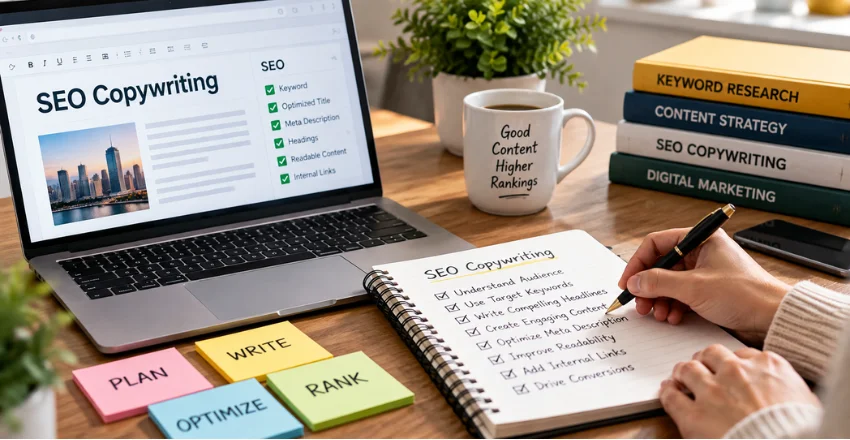
Rankings are useful diagnostics, but they do not show whether a page creates business value. Track impressions, clicks, relevant queries, and landing-page engagement alongside leads or sales. The final metric should match the action the page was built to generate.
| Metric | What it helps answer |
|---|---|
| Impressions | Is the page becoming visible for relevant searches? |
| Organic clicks | Are searchers choosing the result? |
| Query mix | Is the page attracting the intended audience? |
| Conversion rate | Are qualified visitors taking the next action? |
| Leads or sales | Is the page contributing measurable business value? |
| Assisted conversions | Does the page help earlier in a longer buying journey? |
Review the page when impressions rise but clicks remain weak. Revisit the title and search-result promise before rewriting the entire article. If traffic grows but conversions stay flat, examine the offer, proof, CTA, and response path.
Turn Search Demand Into Useful Customer Actions
Start with one query, one reader need, and one business outcome. Build a page that answers the search clearly before asking the visitor to act. Then measure whether the traffic becomes qualified leads, bookings, purchases, or another meaningful result. The practical standard is simple: every section should help the reader understand or decide something.
Remove sentences that exist only to carry keywords or fill space. When relevance and persuasion support the same goal, organic traffic becomes more useful to the business.
Frequently Asked Questions
How often should I use the exact keyword in SEO copywriting?
Google doesn’t recommend a universal keyword-density percentage. Use the phrase where it improves clarity, then use natural alternatives throughout the page. Repetition becomes a problem when the language sounds unnatural or appears designed to manipulate rankings.
How long should search-focused copy be?
There is no preferred Google word count for a page. The copy should be long enough to answer the query and support the intended decision. Stop when additional words no longer add useful information or reduce uncertainty.
Is this the same as SEO content writing?
The terms overlap, and different publishers define them differently. A practical distinction is that content writing usually emphasizes education and discovery. Conversion-focused search copy gives more weight to offers, proof, objections, and measurable actions.
Can AI help write search-optimized copy?
AI can help organize research, generate alternatives, or accelerate a first draft. Human review still needs to verify accuracy, originality, audience fit, and the business promise. Google’s policies target low-value, scaled content made to manipulate rankings, regardless of how it’s produced.