
If you’re learning how to advertise your business, don’t start by opening an ad account. Start by deciding who you want to reach, what you want them to do, and what a new customer is worth. Those answers make it much easier to choose a channel and control your budget.
Short answer: To advertise a business effectively, start with one customer goal, define who you need to reach, and choose the channel that matches how they buy. Prepare a clear offer and conversion path, set a test budget, track leads or sales, and then shift spending toward ads and channels that drive profitable customer actions.
Advertising plan at a glance
| Stage | What to decide | Practical outcome |
|---|---|---|
| Goal | Sale, lead, booking, call, or store visit | One measurable target |
| Audience | Who needs the offer and why | Clear customer profile |
| Budget | What a customer is worth | Spending limit |
| Channel | Where buying intent appears | Focused campaign |
| Message | Problem, benefit, proof, CTA | Clear advertisement |
| Tracking | What counts as a conversion | Reliable performance data |
| Testing | What variable to compare | Useful learning |
| Scaling | Where profitable results appear | Smarter budget allocation |
What you’ll need before you advertise
Paid promotion works better when the basics are ready. Sending more visitors to a confusing offer rarely fixes the underlying problem.
Before launching a campaign, prepare:
- A specific product, service, or offer.
- A clear description of your ideal customer.
- One main action you want people to take.
- A website, landing page, phone line, or profile that supports that action.
- A simple way to record leads, purchases, bookings, or calls.
Local businesses should also check their Google Business Profile. Eligible businesses can claim a profile at no charge and manage how their information appears on Google Search and Maps.
How to Advertise Your Business in 9 Steps
- Choose one business goal. Decide whether the campaign should produce sales, calls, appointments, quote requests, store visits, or another measurable action. Avoid starting with a vague goal such as “get more exposure.”
- Define the customer you want to reach. Describe the buyer’s problem, location, priorities, and likely point in the buying process. A local emergency service needs a different audience from a fashion brand introducing a new product.
- Set a customer-acquisition limit. Work backward from the economics of a sale. For example, assume a new customer generates $120 in gross profit, and you can spend 25% of that amount on acquisition. Your target acquisition cost would be $30. That is an example, not an industry benchmark.
- Pick the channel that matches customer intent. Search advertising suits people who are already looking for a solution. Social ads can introduce an offer before someone actively searches for it. Local promotion can work when geography influences the purchase decision. AdsPaper’s overview of digital advertising services explains the main online formats in more detail.
- Prepare the destination before buying traffic. The page or profile should repeat the promise made in the ad. Make the price, offer, contact method, proof, and next action easy to find. Remove unnecessary steps between interest and conversion.
- Write one clear advertising message. Lead with the customer’s problem or desired result. Follow it with the benefit, useful proof, and a specific call to action. A local cleaner might use: “Same-week house cleaning in [City]. Get a flat-rate quote online.”
- Set up conversion measurement. Track the action that matters to the business rather than just clicks or views. Google Ads supports conversion measurement for actions such as purchases, sign-ups, website actions, and phone calls. AdsS Paper also explains how to connect marketing touchpoints to closed sales.
- Run a focused test. Start with one main channel and a limited set of audiences, keywords, or creative versions. Changing five things at once makes the results harder to interpret. Give the campaign enough time and data to reveal a useful pattern before making a decision.
- Move money based on customer results. Compare conversions, cost per acquisition, revenue, and return on ad spend where relevant. Reduce spending on campaigns that attract attention but fail to generate customers. Expand only after the original campaign produces stable results. AdsS Paper’s guide on when to expand a CPC campaign covers the signals to review before entering new markets.
Where should a small business advertise?
The right channel depends more on customer behavior than on popularity. A platform with millions of users can still be a poor choice if your buyers don’t use it when making the relevant purchasing decision.
| Channel | Best fit | Main strength | Key metric |
|---|---|---|---|
| Google Search Ads | Services and products people actively search for | Captures existing demand | Conversions and CPA |
| Facebook and Instagram ads | Visual offers, consumer products, awareness | Reaches defined audiences | Conversions and CPA |
| Google Business Profile | Eligible local businesses | Free local Search and Maps presence | Calls, visits, actions |
| Existing leads and customers | Direct audience access | Sales, replies, clicks | |
| Referrals | Trust-driven services | Strong recommendation signal | Qualified leads |
| Local print, signage, or events | Geographic markets | Physical local visibility | Calls, visits, codes |
A useful rule is simple: use search when customers already know what they need; use social when you need to introduce the offer.
Businesses that rely heavily on Facebook, Instagram, or other networks can also use AdsS Paper’s social media marketing guides for channel-specific ideas.
How to advertise without a large budget
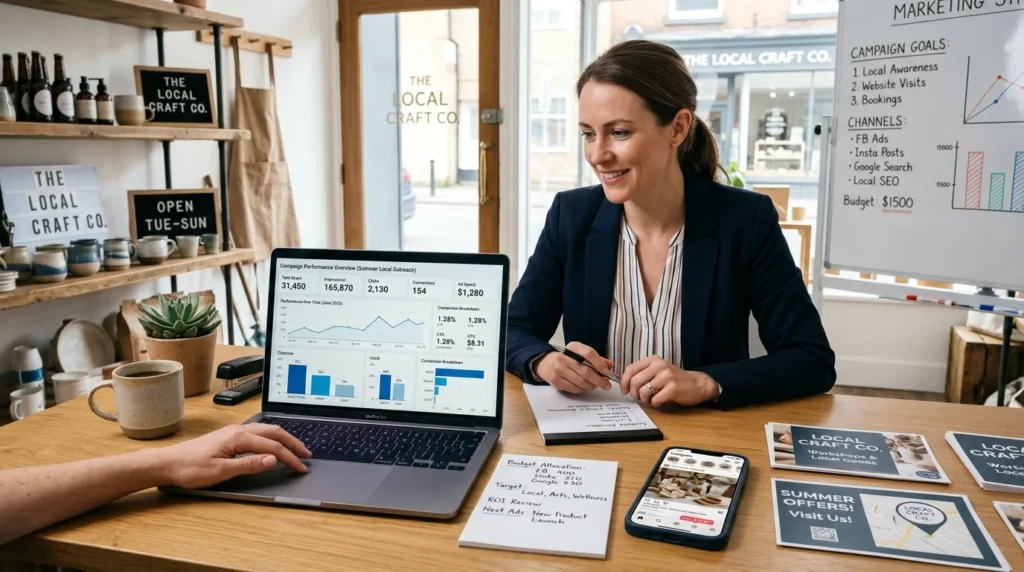
You don’t need paid media for every part of your promotion. Start with assets you control or can access without paying for each impression.
For an eligible local company, complete and maintain your Google Business Profile. Ask satisfied customers for reviews without offering prohibited incentives. Publish useful answers to common buying questions on your site. Share those answers through the social platforms your customers use.
Email past customers when you have a relevant offer. Build referral relationships with businesses that serve the same audience without competing directly. Local associations, events, partnerships, directories, and community groups can also increase your visibility.
Free promotion still costs time. Track where inquiries come from so you know which activities deserve more attention.
Google Ads or social media ads?
Choose Google Search Ads when a customer is likely to search for a product or a solution to a problem shortly before making a purchase. Examples include emergency repairs, legal services, local contractors, and specific professional services.
Choose paid social when the offer benefits from discovery, visual demonstration, repeated exposure, or interest-based targeting. Clothing, beauty, food, events, and visually distinctive consumer products often fit this pattern.
You don’t need both at the beginning. A small budget spread across several platforms may produce too little useful information from any one channel. Learn from one focused campaign before adding another.
Common advertising mistakes that waste money
- Paying for traffic before the offer and landing page are ready.
- Trying several channels with a budget that can support only one.
- Targeting an audience so broadly that the message becomes generic.
- Measuring clicks, followers, or impressions without tracking customers.
- Writing ads about the company instead of the buyer’s problem.
- Changing the audience, offer, creative, and budget simultaneously.
- Increasing spending before the campaign has shown repeatable results.
Advertising should generate insights as well as customers. Even a campaign that misses its target should tell you something useful about the audience, the offer, the message, or the channel.
Your next move
Don’t begin by asking which advertising platform is most popular. Pick one customer, one offer, one conversion, and one channel.
Set up measurement before the campaign starts. Run a focused test, review the cost of real customer actions, and improve the weakest part of the path. Once the numbers make business sense, you have a reason to spend more.
Frequently asked questions
Start where purchase intent is easiest to identify. A local service with active search demand may begin with Google Search and a Business Profile. A visual consumer brand may learn faster from paid social. Businesses with an existing customer list should also test email before paying to reacquire the same audience.
If you’re learning how to advertise your business for free, start with your Google Business Profile if you’re eligible, useful website content, customer referrals, email, organic social posts, local partnerships, and relevant directories. Pick two or three activities you can maintain consistently rather than creating inactive profiles everywhere.
There isn’t one correct amount for every company. Base your limit on customer value, gross profit, conversion performance, and available cash. Set an allowable acquisition cost first, then choose a test budget that won’t put normal operations at risk.
Neither platform is better for every business. Google Search is useful for capturing existing intent. Facebook and Instagram are often better suited to audience discovery, visual products, and offers that people may not yet be searching for.
Connect each campaign to a business outcome. Track qualified leads, purchases, bookings, phone calls, customer-acquisition costs, and revenue where possible. Google recommends conversion measurement because it connects ad interactions with valuable actions and helps identify stronger ads and keywords.