


Introduction
Launching an app is only the beginning of building a sustainable business. You need a repeatable way to attract suitable users, encourage their first meaningful action, and give them reasons to return. A practical mobile app marketing strategy connects every stage instead of treating downloads as the final goal. For startups, limited budgets make prioritization essential. You don’t need to run every advertising channel simultaneously or hire a large growth department. You need a clear audience, a convincing store listing, reliable measurement, and consistent improvements throughout the user journey.
Mobile App Marketing at a Glance
| Funnel stage | Main objective | Recommended activities | Key measurements |
|---|---|---|---|
| Pre-launch | Validate demand | Positioning, landing page, waitlist, beta testing | Sign-ups, feedback |
| Launch | Generate initial visibility | ASO, Product Hunt, PR, launch announcements | Store conversion, installs |
| Acquisition | Attract suitable users | Apple Ads, Google Ads, social ads, creators | CPI, CAC |
| Activation | Deliver the first meaningful result | Onboarding, tutorials, personalization | Activation rate |
| Retention | Encourage repeat usage | Push, email, in-app messages | D1, D7, D30 retention |
| Monetization | Generate sustainable revenue | Subscriptions, purchases, advertising | ARPU, LTV |
| Measurement | Improve business decisions | Analytics, attribution, cohort analysis | Churn, payback |
Quick Takeaways
- Validate your audience and value proposition before spending heavily on advertising.
- Prepare your store listing, screenshots, and testing process before launch.
- Start with a small number of acquisition channels that match customer behavior.
- Measure activation and retention alongside downloads.
- Choose monetization methods that fit the product’s actual value.
- Increase acquisition spending only when user quality and unit economics support it.
1. Pre-Launch: Build Demand Before Releasing Your App
Pre-launch preparation helps you understand whether people want your product. It also gives your team time to improve messaging, identify usability problems, and prepare launch materials. Start these activities before your public release rather than waiting for the app store listing to go live.
Define positioning and your target audience
Describe your ideal customer in specific terms. Identify their main problem, current alternatives, and the outcome your product promises. A clear positioning statement should explain who the product serves, what it helps them accomplish, and why they should choose it. For example, a budgeting app could target freelancers who struggle to separate business expenses from personal spending. Its messaging might promise simpler expense tracking and clearer monthly cash-flow visibility. This positioning gives your advertisements, landing page, and store listing a consistent message.
Create a landing page and waitlist
Build a simple website explaining the product and its primary benefit. Include screenshots or a short demonstration, a clear signup form, and an estimated launch timeline. Collect email addresses from people who want early access or product updates. Use the landing page to test different value propositions. Compare messaging based on qualified sign-ups and feedback rather than traffic alone. Your waitlist can also become an initial audience for launch announcements.
Run beta testing
Test the product with real users before public release. For iOS, distribute builds through Apple’s TestFlight program and collect structured feedback. For Android, use Google Play’s internal, closed, or open testing tracks, depending on your testing needs. Ask testers to complete important tasks without assistance. Record crashes, confusing screens, onboarding problems, and missing features. Give testers a clear feedback channel.
Prepare a press kit
Create a small media folder that journalists, creators, and potential partners can access. Include your product description, founder biography, logo files, screenshots, brand assets, and contact information. Add a short demonstration video and a clear explanation of the problem your product solves.
2. Launch: Make Your App Store Listing Convert
A launch should bring attention to a product that is ready for public use. Your store listing acts as a sales page, so its message must match the advertisement or recommendation that brought visitors there. Prepare the listing before launch and review its performance afterward.
Improve App Store Optimization
App Store Optimization (ASO) helps people discover your product through store searches and category browsing. Focus on relevant search terms, clear messaging, useful visuals, and credible ratings. Avoid adding unrelated keywords simply to attract more impressions. For Apple’s App Store, pay attention to these elements:
- App title: Use a recognizable product name with relevant descriptive wording.
- Subtitle: Explain the primary benefit within Apple’s character limit.
- Keywords field: Select relevant search terms and use the available character allowance carefully.
- Screenshots: Show meaningful product benefits through actual interface images.
- App previews: Demonstrate important features through short videos.
- Ratings and reviews: Invite honest feedback after users experience genuine value.
Apple allows subtitles up to 30 characters, keywords up to 100 characters, and up to 10 screenshots. For Google Play, write a concise short description and a detailed long description. Explain the main problem, important features, and practical benefits using natural language. Add relevant screenshots and a suitable promotional graphic.
Coordinate launch announcements
Choose a launch date and coordinate your communication across several channels. Prepare email announcements, social posts, founder updates, and community messages in advance. Make sure every announcement directs interested users to the correct store listing. Consider these launch opportunities:
- Product Hunt: Present your product to a technology-focused discovery community.
- Launch PR: Pitch relevant technology publications, niche newsletters, and journalists.
- Founder networks: Ask professional contacts and early supporters to share genuine feedback.
- Online communities: Participate in relevant communities without posting repetitive promotional messages.
Do not depend on one launch-day spike. Build a publishing schedule that continues introducing the product after release.
3. Acquisition: Find the Right Users
Acquisition works best when channels match your audience and business model. A productivity tool, mobile game, shopping app, and financial product may require different distribution strategies. Start with a small channel mix and compare the quality of users each channel attracts.
Apple Search Ads
Apple Ads can help your product appear in App Store search advertising placements. Test relevant keywords that reflect the problems people want to solve. Separate branded searches from non-branded searches to understand where demand originates. Review spend alongside installs, activation, and downstream revenue. A campaign producing inexpensive downloads may still perform poorly if those users never complete onboarding.
Google App Campaigns
Google App Campaigns promote applications across eligible Google advertising inventory. They use campaign assets and conversion signals to support automated delivery and optimization. Prepare useful text, image, and video assets before launching campaigns. Set meaningful conversion goals where measurement permits. Review the quality of acquired users rather than judging campaigns by install volume alone.
Meta and TikTok advertising
Meta advertising can help reach audiences through Facebook and Instagram placements. TikTok can support discovery through short-form demonstrations, creator-style videos, and product education. Test different creative concepts instead of relying on one advertisement. Useful creative approaches include:
- Demonstrating a common customer problem.
- Showing the product completing a real task.
- Explaining one feature through a short tutorial.
- Comparing an old workflow with the product experience.
- Presenting authentic customer feedback with permission.
For additional campaign guidance, see AdsS Paper’s paid social advertising guide.
Influencers, referrals, and organic discovery
Work with creators whose audiences match your ideal customers. Smaller niche creators may provide more relevant conversations than broad lifestyle accounts. Agree on deliverables, disclosure requirements, usage rights, and tracking arrangements before publishing sponsored content. Create referral incentives that reward genuine recommendations. Offer existing customers a useful benefit for inviting friends, while keeping the referral process simple. Content marketing and SEO can support long-term discovery through tutorials, comparisons, product education, and problem-solving articles. Cross-promotion can also introduce your product to complementary audiences. Partner with non-competing apps, newsletters, communities, and businesses serving similar customers.
4. Activation: Help New Users Experience Value
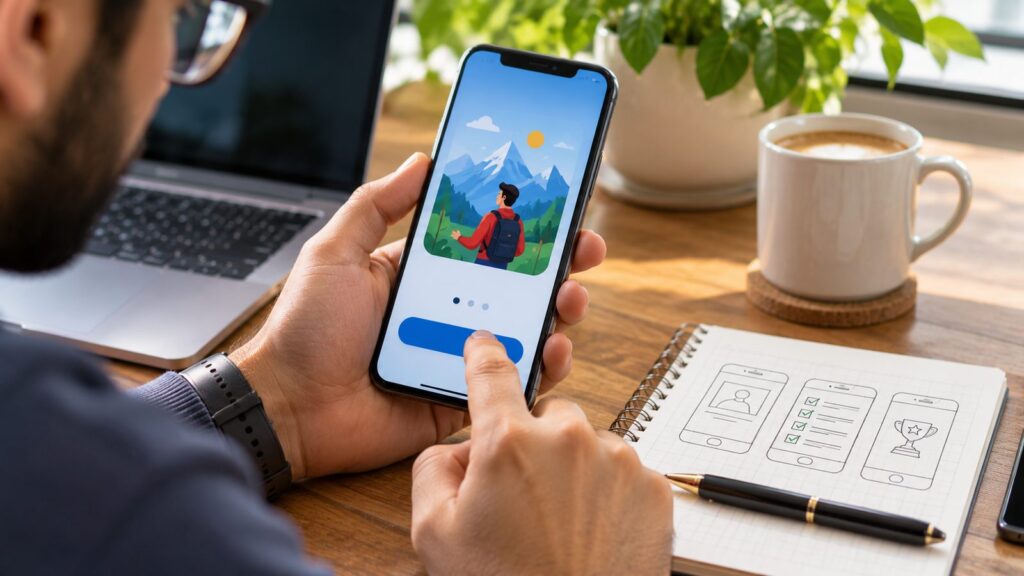
An installation does not automatically represent a successful acquisition. Users must understand what the product does and complete an action that demonstrates its value. This first meaningful action is commonly called activation. Reduce unnecessary onboarding steps. Ask only for information needed to personalize or operate the experience. Use guided prompts, sample content, and contextual explanations to help users reach their first result. For example, a meal-planning app could guide new users through selecting dietary preferences and creating their first weekly plan. Measure how many new users complete that action and how long completion takes. Test onboarding changes against activation outcomes instead of relying on opinions.
5. Retention: Give Users Reasons to Return
Retention measures whether people continue finding value after installation. Poor retention can make paid acquisition uneconomical, even when initial download costs appear attractive. Review user behavior by signup date, acquisition channel, and meaningful product actions.
Use push notifications thoughtfully
Push notifications can remind users about relevant activity, unfinished tasks, or useful updates. Request permission when the value of notifications is clear, rather than immediately presenting an unexplained permission request. Respect notification preferences and provide controls to manage message frequency.
Add in-app messaging and email
Use in-app messages to explain relevant features or guide users through important actions. Email marketing can support account updates, product education, subscription information, and re-engagement. Segment messages based on actual user behavior rather than sending identical campaigns to everyone.
Build lifecycle campaigns
Create communication journeys for different user stages:
- New users receive onboarding guidance.
- Active users discover relevant features.
- Paying customers receive useful product updates.
- Inactive users receive appropriate win-back messages.
- Users approaching renewal receive clear subscription information.
Review campaign performance and unsubscribe behavior regularly. Every message should offer a useful reason to engage.
6. Monetization: Choose a Model That Fits Your Product
Your revenue model should reflect the value users receive and how frequently they use the product. Avoid introducing aggressive monetization before users understand its benefits. Test pricing and presentation while monitoring conversion, cancellations, and customer satisfaction.
| Model | How it works | Suitable examples |
|---|---|---|
| Freemium | Basic features are free; advanced features require payment | Productivity and education |
| Subscription | Users pay recurring fees for ongoing access | Fitness and content apps |
| Advertising | Revenue comes from displayed advertisements | Free utilities and games |
| In-app purchases | Users purchase digital features or items | Games and creative apps |
Freemium models can attract users before introducing paid features. Subscriptions work when the product delivers continuing value. Advertising requires careful placement because intrusive formats can damage the user experience. In-app purchases can suit products offering optional upgrades or digital goods. Explain pricing clearly and follow applicable platform billing requirements. Compare revenue by user cohort to understand which model supports sustainable growth.
7. Measurement: Track the Full Growth Funnel
Analytics helps your team understand where users discover the product and what happens afterward. Set up event tracking before launch so important actions are not missed. Establish a consistent reporting schedule and assign responsibility for reviewing the results.
Essential metrics
| Metric | Formula or meaning | Why it matters |
|---|---|---|
| Installs | Number of attributed installations | Measures acquisition volume |
| CPI | Advertising spend ÷ attributed installs | Measures paid install cost |
| CAC | Acquisition costs ÷ new customers acquired | Measures customer acquisition efficiency |
| D1 retention | Users active on day one ÷ eligible install cohort | Measures early return behavior |
| D7 retention | Users active on day seven ÷ eligible install cohort | Measures first-week retention |
| D30 retention | Users active on day 30 ÷ eligible install cohort | Measures longer-term engagement |
| LTV | Expected revenue per customer over their lifetime | Estimates customer value |
| ARPU | Revenue ÷ active users during a period | Measures average revenue |
| Churn | Customers lost during a period ÷ customers at the beginning | Tracks customer loss |
Define retention windows and eligible cohorts consistently. Different analytics systems may use different attribution and activity definitions. Document those choices before comparing results.
Understand LTV and CAC with a worked example
Lifetime Value (LTV) estimates the revenue a customer generates during their relationship with your business. A simplified subscription calculation is: LTV = Average monthly revenue per customer × Gross margin ÷ Monthly customer churn rate Suppose a subscription app earns $12 monthly per paying customer. Assume a 75% gross margin and monthly customer churn of 5%. LTV = $12 × 0.75 ÷ 0.05 = $180 Now assume the business spends $1,800 acquiring 60 new paying customers. Its customer acquisition cost is: CAC = $1,800 ÷ 60 = $30 The simplified LTV-to-CAC ratio is $180 ÷ $30 = 6:1. These are illustrative assumptions, not industry benchmarks or a forecast of actual performance.
Calculate CAC payback
CAC payback estimates how long it takes to recover acquisition costs through gross profit. Use this simplified formula: CAC payback period = CAC ÷ Monthly gross profit per customer Using the same example, monthly gross profit equals $12 × 75%, or $9. Payback is $30 ÷ $9 = approximately 3.33 months. This calculation assumes stable monthly revenue and margin. Real subscription businesses should account for billing timing, refunds, discounts, and changing churn. Compare payback with cash-flow needs and the actual retention behavior of customer cohorts.
Understand attribution and privacy changes
Mobile measurement partners (MMPs) can help consolidate campaign attribution and measurement. They may connect advertising interactions with installs, in-app events, and revenue signals. Choose a provider based on platform coverage, integrations, reporting needs, and privacy practices. Apple introduced App Tracking Transparency with iOS 14.5. Apps must request permission before tracking users across other companies’ apps and websites or accessing the advertising identifier for that purpose. Apple’s privacy-preserving attribution technologies include SKAdNetwork and AdAttributionKit, which support campaign measurement with different privacy protections. For Android, Google’s Privacy Sandbox initiative has changed direction, and Google has announced it is retiring most of its Privacy Sandbox technologies. Check Google’s current Privacy Sandbox status page before planning around any Android attribution API, and do not build your measurement strategy around an assumption that those APIs remain a permanent attribution solution.
Follow general privacy and consent practices
Explain data collection clearly and request consent when applicable laws or platform rules require it. Collect only information needed for defined product and business purposes. Review third-party SDK behavior, data retention, security, and sharing practices. Keep Apple’s App Store privacy details and Google Play Data safety declarations accurate. Make sure these disclosures reflect the app’s actual behavior, including third-party integrations. U.S. businesses should also review applicable state privacy laws and other relevant requirements with qualified legal counsel.
8. Your First 90 Days: A Practical Launch Plan
A 90-day roadmap helps a small team coordinate product readiness, distribution, and measurement. The following schedule assumes development is already underway and the product can reach a testable release. Adjust individual activities to match your approval timelines and available resources.
| Period | Priorities | Deliverables | Success signals |
|---|---|---|---|
| Days 1–15 | Positioning and research | Audience definition, competitor review, value proposition | Clear target audience and messaging |
| Days 16–30 | Pre-launch preparation | Landing page, waitlist, beta recruitment, press kit | Qualified sign-ups and useful feedback |
| Days 31–45 | Product and listing readiness | TestFlight, Play testing, ASO, screenshots, analytics | Resolved critical issues and completed listings |
| Days 46–60 | Public launch | Store release, Product Hunt, PR, email and social announcements | Initial installs and activation data |
| Days 61–75 | Acquisition experiments | Apple Ads, Google campaigns, paid social, creator tests | Channel-level CPI and user quality |
| Days 76–90 | Retention and monetization | Onboarding tests, lifecycle campaigns, pricing review | Cohort retention, revenue, CAC analysis |
Hold a weekly growth review throughout the plan. Identify the biggest funnel problem and assign one owner to address it. Avoid expanding campaign spending simply because the launch generated initial attention.
Frequently Asked Questions
What is mobile app marketing?
Mobile app marketing covers the activities that attract, activate, retain, and monetize users. It includes pre-launch research, app store optimization, advertising, content, onboarding, lifecycle communication, and analytics. Its purpose is to build a repeatable path from discovery to long-term customer value.
How can startups promote an app with a limited budget?
Start with a clear landing page, organic content, relevant communities, and app store optimization. Use beta testers and early customers to improve product messaging and identify usability problems. Introduce small paid experiments after you can measure activation and retention.
Which advertising platforms are useful for app installs?
Apple Ads can capture App Store search demand, while Google App Campaigns support acquisition across Google’s eligible inventory. Meta and TikTok offer additional opportunities through social advertising and video creative. Select platforms based on audience fit, measurement availability, and user quality.
How can an app improve user retention?
Make onboarding simple and help users experience meaningful value quickly. Use relevant push notifications, in-app messaging, and email to support ongoing engagement. Analyze retention cohorts to identify when users leave and which product improvements address their reasons.
How much does mobile app marketing cost?
There is no universal marketing budget for every application. Costs depend on competition, audience, product category, creative requirements, and acquisition channels. Start with a controlled testing budget and use actual CAC, retention, and LTV data to guide spending.
What should startups measure after launching an app?
Track installs, store conversion, CPI, CAC, activation, and D1, D7, and D30 retention. Add ARPU, LTV, churn, and CAC payback when monetization data becomes available. Review these metrics together rather than treating download volume as the main measure of success.
Conclusion: Build Growth Around Users, Not Downloads
A sustainable acquisition strategy begins with a product that solves a specific problem. Strong positioning, useful store listings, relevant distribution, and effective onboarding help attract people who can benefit from the experience. Retention, monetization, and accurate measurement then show whether that acquisition creates lasting business value. Start with the first 90-day roadmap and choose a manageable set of priorities. Review results weekly, fix the weakest funnel stage, and expand only when the evidence supports it. Small teams can build meaningful growth through consistent execution and careful decisions rather than trying every channel at once. —